Depression Screening Instruments: How to Understand Common Tools
Depression screening instruments are structured questionnaires that help people notice patterns in mood, interest, sleep, energy, concentration, appetite, self-worth, and safety. They are not a final answer about your mental health. They are a way to organize what you have been feeling so a next conversation can be clearer. If you are exploring symptoms privately, a private PHQ-9 self-reflection tool can give you a simple starting point before you decide whether to speak with a clinician, therapist, counselor, or trusted support person. This guide explains how common instruments differ, why the PHQ-9 is widely used, and how to think about depression assessment questionnaires without putting too much weight on any single score.
What Depression Screening Instruments Are Designed to Do
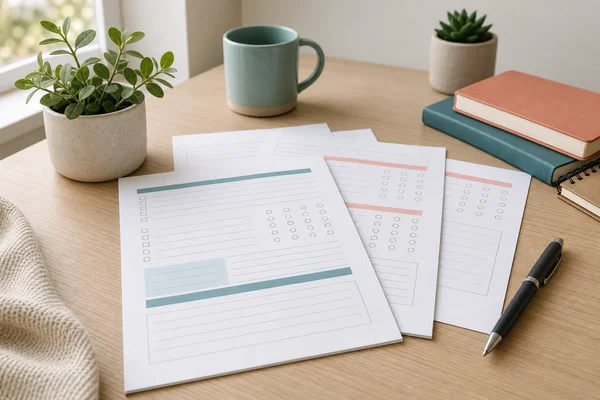
A depression screening instrument is usually brief, standardized, and scored in a consistent way. Instead of asking, "Am I depressed?" in a vague way, the tool asks about specific experiences over a set period. A good depression assessment questionnaire helps turn a cloudy feeling into a more concrete pattern: how often symptoms appear, how much they affect daily life, and whether further support may be worth considering.
Screening is different from a full mental health evaluation. A screening result can suggest that symptoms deserve attention, but it cannot explain the whole story. Grief, trauma, burnout, chronic illness, medications, substance use, sleep problems, thyroid issues, and anxiety can all affect mood. Culture, language, age, disability, and current stress can also shape how someone answers questions.
That is why these tools work best as conversation aids. They can help you prepare for a visit, monitor changes over time, or notice when a hard week has become a repeating pattern. They are also useful in clinics because they make follow-up more consistent. Still, a score should be paired with context: what changed, what helps, what feels worse, and what kind of support is available.
Common Screening Instruments for Depression
There is no single best tool for every person. The right choice depends on age, setting, purpose, language, time available, and whether the goal is quick triage, symptom tracking, research, or a deeper clinical conversation.
PHQ-9
The PHQ-9 is one of the most common screening instruments for depression. It includes nine items that ask how often symptoms have been present during the past two weeks. Each item is usually scored from 0 to 3, creating a total score from 0 to 27. Many people search for a depression assessment tool PHQ 9 because it is short, familiar in primary care, and easy to repeat over time.
The PHQ-9 is helpful because it covers both emotional symptoms, such as low mood and loss of interest, and body-related symptoms, such as sleep, appetite, and energy changes. It also asks about thoughts of self-harm. If that item feels relevant, it is important to seek immediate support from local emergency services, a crisis line, or a qualified professional.
For personal reflection, the PHQ-9 can help you see whether symptoms are minimal, mild, moderate, or more intense. For care conversations, it can help you describe what has changed since a previous visit. It should not be treated as a stand-alone verdict about who you are or what will happen next.

PHQ-2
The PHQ-2 is a two-question quick screen based on the first two PHQ-9 themes: low mood and loss of interest or pleasure. It is often used when time is limited. If responses suggest concern, a longer tool such as the PHQ-9 may follow.
The PHQ-2 is useful because it lowers the barrier to checking in. Its limitation is also its strength: two questions cannot capture the full range of depression symptoms. It is better as an opening door than as a complete picture.
CES-D
The Center for Epidemiologic Studies Depression Scale, often called the CES-D, has been used in research and population health settings. It asks about depressive symptoms over a recent period and can be useful when the goal is to understand symptom patterns across groups.
Compared with the PHQ-9, the CES-D is usually longer. That extra detail can be valuable in research or structured programs, but it may feel less practical for a quick check-in. People searching for depression screening tools PDF may see the CES-D listed alongside other questionnaires, but availability and scoring instructions can vary by source.
GDS for Older Adults
Depression screening tools for older adults need special care. Older adults may experience depression through irritability, loss of motivation, slowed movement, memory concerns, pain, fatigue, or reduced self-care. Some tools include body symptoms that may overlap with medical conditions, aging-related changes, or medication effects.
The Geriatric Depression Scale, or GDS, was created with older adults in mind and uses a yes/no format that can be easier for some people. There are longer and shorter versions. A clinician may choose the GDS, the PHQ-9, or another tool depending on cognition, vision, hearing, language, and the purpose of the visit.
PHQ-A and Child-Focused Tools
People often search for a child depression screening tool PDF or a depression assessment tool for children, but child and adolescent screening should be handled thoughtfully. Age matters. The words used in a questionnaire, whether a caregiver is involved, and the setting where screening happens can all influence the result.
For adolescents, tools such as the PHQ-A or modified youth-focused questionnaires may be used in health care or school-linked settings. For younger children, evidence and tool choice are more complex. A parent, caregiver, pediatrician, school counselor, or mental health professional can help decide what is appropriate. Any concern about self-harm, sudden behavior change, or safety should be treated as urgent.
PHQ-9 and GAD-7: Depression and Anxiety Screening Together
Many people look for screening tools for depression and anxiety because low mood and anxiety often overlap. The PHQ-9 focuses on depressive symptoms. The GAD-7 focuses on anxiety symptoms, especially worry, nervousness, restlessness, and difficulty relaxing. Used together, they can help separate two related patterns: feeling down, disconnected, or slowed down, and feeling keyed up, worried, or unable to settle.
This pairing can be useful, but it still needs interpretation. A high anxiety score can make depression symptoms feel worse, and depression can make worry harder to manage. Sleep loss, chronic stress, pain, substance use, and major life transitions can affect both scores. The value is not in labeling yourself quickly. The value is in seeing patterns clearly enough to ask better questions.
If you want a gentle place to begin, an online PHQ-9 screening experience can help you organize recent mood symptoms before comparing them with anxiety-related concerns. If anxiety feels like the stronger issue, it may be worth discussing both sets of symptoms with a professional rather than focusing on only one questionnaire.

How to Choose a Depression Assessment Questionnaire
Choosing among depression screening instruments is less about finding the "perfect" questionnaire and more about matching the tool to the situation.
If you want a quick personal check-in, the PHQ-9 is often a practical option because it is brief, structured, and easy to repeat. If you are preparing for a medical appointment, a PHQ-9 score plus a few notes about sleep, appetite, stress, and daily functioning can make the conversation more specific.
If the setting involves older adults, the GDS may be considered, especially when yes/no answers are easier than rating frequency. If the setting involves adolescents, youth-appropriate tools and professional guidance matter. If the goal is research, longer measures such as the CES-D may be more appropriate than a short screen.
For someone searching for an MDD assessment tool, it is important to slow down the language. Major depressive disorder is a clinical term, and a questionnaire alone should not be used as a final determination. A screening instrument can show symptom severity and suggest whether a formal evaluation may be useful. It cannot understand your medical history, relationships, trauma exposure, medications, culture, or current life pressures on its own.
Here is a simple way to think about tool choice:
- For speed: PHQ-2 can open the conversation.
- For common adult mood screening: PHQ-9 is often practical.
- For anxiety plus depression patterns: PHQ-9 and GAD-7 together may be useful.
- For older adults: GDS or a carefully interpreted PHQ-9 may fit.
- For children and teens: age-appropriate tools and adult support are important.
- For research or population-level work: CES-D or other longer measures may be chosen.
How to Use Screening Results Thoughtfully
The safest way to use a score is to treat it as information, not identity. A number can point to a pattern, but it cannot capture your whole life.
Start by looking at the time frame. Most common tools ask about the past one or two weeks. A difficult day can influence answers, but a repeated two-week pattern may say more. Next, look at functional impact. Are symptoms affecting work, school, relationships, hygiene, food, movement, or sleep? A moderate score with serious daily disruption may deserve attention even if the number does not look extreme.
Then look at item patterns. Two people can have the same total score for very different reasons. One person may mainly report sleep and fatigue. Another may report low mood, guilt, and loss of interest. Those patterns matter because the next step may be different.
It can also help to repeat the same tool under similar conditions. If you complete a questionnaire weekly, try to do it at a similar time and in a similar state. Tracking can reveal whether symptoms are easing, intensifying, or staying flat. However, repeated scoring can become stressful for some people. If checking too often makes you feel more worried, it is reasonable to step back and use the tool less frequently.
Finally, pair the score with human support. Bring the result to a clinician if symptoms persist, intensify, or interfere with daily life. If you feel unsafe or may harm yourself, seek immediate local crisis support. You do not have to wait for a certain score to ask for help.
A Calm Next Step for Understanding Your Mood
Depression screening instruments are most useful when they make the next conversation easier. They can help you name what has been happening, notice whether symptoms are changing, and decide whether more support would be helpful. They are less useful when they become a way to judge yourself or force a single answer.
If you are comparing tools, begin with your purpose. Do you want a quick check-in, a printable depression assessment questionnaire, an older-adult screen, a child-focused conversation starter, or a way to discuss depression and anxiety together? Once the purpose is clear, the tool choice becomes simpler.
For many adults, a gentle PHQ-9 starting point is enough to organize recent symptoms and prepare for a thoughtful next step. Use the result as a prompt for reflection, not as a label. If your answers raise concern, or if symptoms are affecting your safety, relationships, work, school, or ability to care for yourself, consider speaking with a qualified professional.
FAQ
What instruments are used to screen for depression?
Common depression screening instruments include the PHQ-9, PHQ-2, CES-D, GDS, and youth-focused tools such as the PHQ-A. Clinicians may also use broader mental health questionnaires when anxiety, trauma, substance use, or bipolar symptoms need to be considered. The best option depends on age, setting, purpose, and follow-up support.
What is the PHQ-9 screening instrument for depression?
The PHQ-9 is a nine-item questionnaire that asks about depressive symptoms over the past two weeks. It produces a total score from 0 to 27 and can help estimate symptom severity. It is widely used because it is brief, structured, and easy to repeat, but it should be interpreted with personal and clinical context.
What are GAD-7 and PHQ-9 screening tools?
The PHQ-9 focuses on depression symptoms, while the GAD-7 focuses on anxiety symptoms. They are often used together because anxiety and depression can overlap. A combined view may help someone describe whether low mood, loss of interest, worry, restlessness, or sleep disruption is most prominent.
What assessment tools are used for depression?
Depression assessment tools can include self-report questionnaires, clinician-led interviews, symptom checklists, functional assessments, and safety questions. The PHQ-9 is common for adults, the GDS is often considered for older adults, and youth-focused tools may be used for adolescents. A full evaluation usually includes more than a score.
Are depression screening tools PDF forms reliable?
A PDF form can be useful if it comes from a reputable source and includes clear scoring guidance. The format itself does not make a tool reliable. What matters is whether the instrument has been studied, whether it fits the person and setting, and whether there is appropriate follow-up when results suggest concern.
Which depression screening tools are used for older adults?
Older adults may be screened with the GDS, PHQ-9, or another tool chosen by a clinician. The GDS was designed for older adults and uses yes/no answers. Tool choice should consider cognition, vision, hearing, medical conditions, medications, and whether body symptoms might reflect something other than depression.
Can a screening instrument tell me if I have major depressive disorder?
A screening instrument can show whether symptoms are present and how intense they may be, but it is not a final clinical answer. Major depressive disorder requires a broader evaluation that considers history, duration, impairment, other health conditions, safety, and professional judgment.