Understanding Depression Screening: A Guide to the PHQ-9 & Your Mental Health
Life has a way of feeling overwhelming. Maybe you've felt persistently low, lost interest in things you used to love, or just feel "off" but can't quite pinpoint why. It's normal to wonder if these feelings are temporary or signs of something deeper like depression.
Acknowledging this uncertainty is brave, but figuring out the next step can be confusing. That’s where a depression screening comes in. Think of it not as a scary exam, but as a simple "emotional check-up"—a way to take a snapshot of your current mental well-being. This guide will walk you through how screenings work, why the PHQ-9 is the trusted standard, and how you can explore your depression screening options safely today.

What Is a Depression Screening Test? (And What It Isn't)
At its core, a depression screening test is a preliminary tool used to identify if you are experiencing symptoms common to depression. It is designed to be quick, accessible, and objective.
Unlike a blood test that gives a definitive biological "yes or no," a mental health screening assesses patterns in your mood and behavior over a specific period, usually the last two weeks. It helps you pause and ask, "How have I actually been feeling lately?" rather than just pushing through the day.
It’s a Snapshot, Not a Label
One common fear is that taking a test will permanently label you. This isn't true. A screening result is simply a snapshot of your mental state at this moment in time.
- It validates your feelings: Seeing your symptoms listed can help you realize you aren't "just lazy" or "making it up."
- It tracks changes: You can take a screening multiple times over months to see if your mood is improving or declining.
- It starts a conversation: It gives you concrete language to use if you decide to talk to a friend or doctor.
How the Screening Process Works
The process is straightforward and usually takes less than five minutes.
- You answer a set of questions: These cover key areas of your life like sleep, appetite, and energy.
- A score is calculated: Your answers are tallied into a numerical score.
- You receive an interpretation: The score places you in a category ranging from "None" to "Severe" depression risk.
- You decide the next step: Based on the result, you might monitor your mood yourself or reach out to a professional.
Crucially, a depression screening is NOT a medical diagnosis. It cannot confirm you have clinical depression; only a qualified healthcare professional can do that after a comprehensive evaluation.
Why the PHQ-9 Is the Gold Standard
If you search for "depression test" online, you'll find thousands of quizzes. However, not all are created equal. The PHQ-9 (Patient Health Questionnaire-9) stands out as the most widely used and respected tool in both clinical and research settings globally.
When you use a depression screening PHQ-9 tool, you are using a scientifically validated instrument, not just a random internet quiz.
The Science Behind the 9 Questions
The "9" in PHQ-9 refers to the nine specific criteria for diagnosing major depressive disorder in the DSM-5 (the standard manual used by mental health professionals).
This means the questions aren't random. Each one targets a specific symptom cluster required for a diagnosis. Because it mirrors clinical criteria so closely, the PHQ-9 is exceptionally good at detecting the likelihood of depression and measuring its severity.
Used by Doctors, Available to You
The beauty of the PHQ-9 is its versatility.
- In clinics: Doctors use it to screen patients during routine check-ups.
- In therapy: Therapists use it to track a client's progress week-to-week.
- For you: It is public and free to use for self-assessment.
By using the PHQ-9, you are speaking the same language as mental health professionals. If you ever decide to share your results with a doctor, they will immediately understand what a "score of 15 on the PHQ-9" means.
Inside the Questionnaire: What You Will Be Asked
Fear of the unknown often stops people from taking a depression screening. "What will they ask? Is it intrusive?"
Rest assured, the depression screening questions are standard and non-judgmental. They focus on how often you've been bothered by specific problems over the last 2 weeks. Here is a breakdown of what to expect.
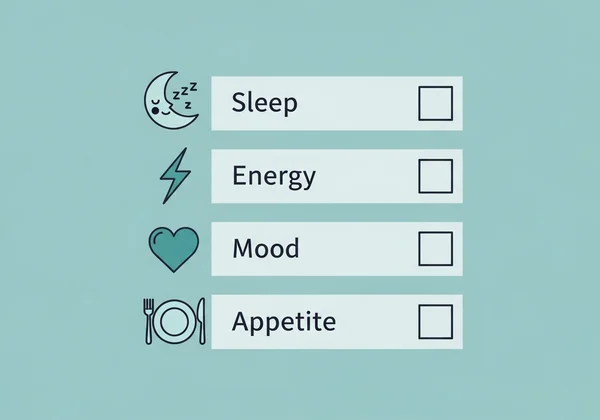
Physical Signs (Sleep & Energy)
Depression isn't just "in your head"; it's in your body, too. The screening asks about:
- Sleep patterns: Trouble falling asleep, staying asleep, or sleeping too much.
- Energy levels: Feeling tired or having little energy.
- Appetite: Poor appetite or overeating.
- Focus: Trouble concentrating on things like reading or watching TV.
- Movement: Moving or speaking so slowly that others could have noticed, or being so fidgety you can't sit still.
Emotional Signs (Mood & Interest)
These questions target the core emotional experiences of depression:
- Anhedonia: Little interest or pleasure in doing things.
- Mood: Feeling down, depressed, or hopeless.
- Self-worth: Feeling bad about yourself—or that you are a failure or have let yourself or your family down.
"Why Do You Ask That?": The Logic Behind the Questions
You might wonder why a mental health test asks about lunch or sleep.
The logic is simple: Mental health affects your physiology. Often, changes in sleep or appetite appear before you notice feeling "sad." By capturing these physical signs, the screening can identify depression that might otherwise be masked as just "fatigue" or "stress."
Taking the First Step: Your Free, Private Check-up
Now that you understand the "what" and "why," the next logical step is to see where you stand.
Self-reflection is powerful. It shifts you from a passive state of worrying ("Is something wrong with me?") to an active state of understanding ("Here is what my symptoms look like").
Why Self-Reflection is Powerful
- Clarity: It organizes your vague feelings into clear data.
- Privacy: You can explore this safely on your own terms, without needing to make an appointment or talk to anyone yet.
- Empowerment: Knowing your baseline helps you make informed decisions about your health.
Start Your 3-Minute Anonymous Test
If you are ready to check in with yourself, we offer a free, confidential tool based on the official PHQ-9 standards.
- No Registration Required: You do not need to create an account or give your name.
- Instant Results: Get your score and interpretation immediately.
- Secure: Your data is private.
Explore Your Mental Health with Our Free PHQ-9 Screening Tool
Remember, this is an educational tool for self-discovery, not a diagnosis. It is a safe space to start understanding your needs better.
Interpreting Your Results: What the Scores Mean
You’ve taken the test—now, what does the number mean? The PHQ-9 score interpretation is vital for understanding the severity of your symptoms.
The total score ranges from 0 to 27. Higher scores indicate more severe depressive symptoms.
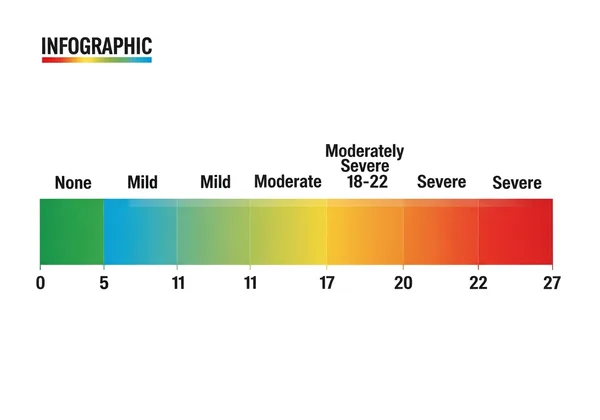
Understanding the Scale (0-27)
Here is the standard breakdown used by clinicians:
- 0–4 (None to Minimal): Few or no symptoms. This is a healthy range.
- 5–9 (Mild): Symptoms are present but may not severely impact daily life. "Watchful waiting" is often recommended.
- 10–14 (Moderate): Symptoms are likely impacting your routine. A professional evaluation is usually recommended to explore support options.
- 15–19 (Moderately Severe): Significant impact on daily life. Active treatment (therapy/medication) is typically considered.
- 20–27 (Severe): Symptoms are severe and likely disabling. Immediate professional attention is strongly advised.
Real-World Examples: Putting Numbers in Context
Numbers can feel abstract. Let’s look at two hypothetical scenarios to make this concrete.
Scenario A: "The Stressed Professional"
- Score: 7 (Mild)
- Context: Alex feels tired and has trouble sleeping but still enjoys weekends and meets work deadlines.
- Meaning: Alex might not have clinical depression but is showing signs of stress or burnout. Monitoring these symptoms is a good idea to prevent them from worsening.
Scenario B: "The Disconnected Student"
- Score: 16 (Moderately Severe)
- Context: Sam has stopped going to classes, feels worthless, and sleeps 12 hours a day.
- Meaning: Sam’s symptoms are interfering with life function. This score suggests a high likelihood of depression that warrants professional support.
What a High Score Actually Means (and What to Do)
If your score is high, don't panic.
A high score validates that your struggle is real and significant. It means you are carrying a heavy load, and you deserve support to lighten it. It does not mean you are "broken" or that you will feel this way forever. High scores are often the strongest catalyst for seeking help, which is the first step toward recovery.
Screening vs. Diagnosis: Understanding the Limit
We must be crystal clear about the boundary between a screening and a medical diagnosis.
A screening test like the PHQ-9 identifies risk and symptom severity. It asks, "How likely is it that this person is depressed?"
A diagnosis, provided by a doctor or psychologist, asks, "Does this person have Major Depressive Disorder, or is there another cause?"
The Role of a Professional
Only a professional can rule out other causes. For example:
- Thyroid issues or vitamin deficiencies can mimic depression symptoms (fatigue, brain fog).
- Bipolar disorder requires a different treatment approach than unipolar depression.
- Grief or temporary life stress might look like depression on a test but not meet clinical criteria.
Therefore, use your screening result as a conversation starter with a doctor, not the final verdict.
When to Seek Immediate Help
Regardless of your score, if you are experiencing any of the following, please seek help immediately:
- Thoughts of hurting yourself or ending your life.
- Hearing voices or seeing things others don't.
- Inability to care for your basic needs (eating, bathing).
If you or someone you know is in crisis, please call or text 988 (in the US) or contact your local emergency services immediately.
Knowledge is Power – Start Your Journey Today
Understanding your mental health shouldn't be a guessing game. By learning about depression screening, you’ve already taken a massive step toward self-care. You now know that these tools are scientific, safe, and designed to help you, not judge you.
Whether you're feeling a little off or deeply struggling, knowing your baseline is empowering. It gives you the data you need to make the best choice for your future happiness. Ready to see where you stand? Take PHQ-9 Depression Screening for yourself right now. It’s free, private, and quick.
Frequently Asked Questions About Depression Screening
How accurate are online depression screenings?
Online screenings using validated tools like the PHQ-9 are highly accurate at detecting symptoms. Research shows the PHQ-9 is 88% effective at detecting major depression. However, accuracy depends on honest answers, and no online tool is 100% accurate for diagnosis. They are best used as a first step to flag potential issues.
Is the PHQ-9 test free?
Yes. The PHQ-9 is a public domain tool. On our site, phq-9.org, the depression screening is completely free to use as many times as you need. There are no hidden costs or paywalls to see your results.
Will my results be shared with anyone?
On our platform, your privacy is paramount. We do not require registration, meaning your results are anonymous. We do not share your personal data with insurance companies or employers. You are the only one who sees your result unless you choose to share it.
How long does the screening take?
The test consists of only 9 primary questions. Most people complete it in less than 3 minutes. It is designed to be a quick check-in that fits easily into a busy day.
Can I take this test for my child or teenager?
The PHQ-9 is validated for adults. For adolescents (ages 12-18), a slightly modified version called the PHQ-A is often preferred. While you can use the PHQ-9 to get a general idea of a teen's symptoms, it is best to consult a pediatrician or child psychologist for age-appropriate evaluation.