What Is Patient Health Questionnaire? PHQ-2, PHQ-9, and Scores Explained
If you have searched for "what is patient health questionnaire," you may be trying to understand a form, a score, or a mental health screening tool before using it yourself. A Patient Health Questionnaire, often shortened to PHQ, is a self-report screening form that asks about recent symptoms and turns your answers into a structured score. It can help you notice patterns, prepare for a conversation with a professional, or compare changes over time. For a private, plain-English place to explore the PHQ-9 format, PHQ-9.org offers an accessible depression screening overview designed as an educational starting point, not a medical diagnosis.

What a Patient Health Questionnaire Means
A Patient Health Questionnaire is a structured set of questions about health symptoms, usually completed by the person being screened. In mental health, the PHQ family grew from the broader PRIME-MD approach and became widely used because it is brief, easy to score, and practical in both clinical and self-reflection settings.
The word "patient" can make the form sound as if it only belongs in a doctor's office. In practice, PHQ tools may appear in primary care, counseling intake forms, research studies, telehealth workflows, school or adolescent health contexts, and online education pages. The common thread is structure: instead of asking "How are you feeling?" in a vague way, the questionnaire asks about specific experiences during a recent time window.
For depression screening, the PHQ-9 focuses on nine symptom areas over the past two weeks. Those areas include mood, interest or pleasure, sleep, energy, appetite, self-perception, concentration, movement or restlessness, and thoughts of self-harm. A related functional question may ask how much these concerns have affected daily life, work, school, home responsibilities, or relationships.
That structure is useful, but it has limits. A PHQ score is not the same as a full professional evaluation. It does not know your medical history, medications, grief, stressors, culture, safety needs, or physical health context. It is best understood as a signal that can help guide reflection and, when needed, a more complete conversation.
How PHQ-2, PHQ-9, and PHQ-4 Fit Together
People often use "Patient Health Questionnaire" as if it means only the PHQ-9. The PHQ family is broader than that, and the number usually tells you how many items are included.
PHQ-2: a two-question first screen
The PHQ-2 contains the first two depression-focused items: little interest or pleasure, and feeling down, depressed, or hopeless. Because it is so brief, it is often used as a first step. A higher PHQ-2 score does not settle what is happening; it simply suggests that a longer tool, a clinical conversation, or another form of follow-up may be appropriate.
PHQ-9: the nine-item depression screen
The PHQ-9 is the version most people mean when they ask what is the patient health questionnaire 9 used for. It includes nine symptom questions scored from 0 to 3, so the total ranges from 0 to 27. Many readers use an online PHQ-9 self-assessment to understand the format before discussing symptoms with a clinician, counselor, or trusted support person.
PHQ-4: a brief mood and anxiety check
The PHQ-4 combines two depression-related items with two anxiety-related items. It is not a replacement for the PHQ-9 or GAD-7, but it can be used as a very short screen when someone needs a quick snapshot of both mood and anxious distress.

What Does the Patient Health Questionnaire Measure?
The PHQ-9 measures how often a person has been bothered by depression-related symptoms during the past two weeks. Each item is answered with a frequency choice: not at all, several days, more than half the days, or nearly every day. Those responses are assigned scores from 0 to 3.
The questionnaire is not just asking whether a symptom exists. It is asking about frequency, which matters because occasional tiredness or sadness is different from symptoms that appear often and interfere with life. The two-week window also helps make the answer concrete. Instead of trying to summarize your whole year, you are reflecting on a recent period.
The nine items cover several domains:
- Emotional symptoms, such as low mood or reduced interest.
- Physical and energy symptoms, such as sleep changes, appetite changes, or fatigue.
- Cognitive symptoms, such as trouble concentrating or harsh self-judgment.
- Observable pace changes, such as moving or speaking slowly, or feeling unusually restless.
- Safety-related thoughts, including thoughts of being better off dead or self-harm.
The last category deserves special care. Any self-harm response should be taken seriously, even when the total score is not high. If you feel at immediate risk of harming yourself or someone else, contact local emergency services or crisis support right away. If the risk is not immediate but the thought is present, it is still worth reaching out to a qualified professional or a trusted person who can stay with you while you seek support.
What Is the Patient Health Questionnaire 9 Used For?
The Patient Health Questionnaire-9 is used to organize information about depression symptoms. Its value is partly personal and partly practical.
For an individual, the PHQ-9 can make vague distress easier to name. Someone may know they feel "off" but not realize that sleep, appetite, concentration, and low interest are all part of the same pattern. Seeing the questions together can make the pattern more visible.
For a healthcare conversation, the PHQ-9 can make communication more specific. Instead of trying to remember every symptom in the appointment, a person can say which areas were frequent and how much daily function was affected. The score can also create a baseline. If a professional recommends support, therapy, lifestyle adjustments, medication discussion, or monitoring, later scores may help show whether symptoms are changing.
For education, the PHQ-9 helps explain why depression screening is more than a single mood question. Depression can show up as irritability, low motivation, sleep disruption, appetite shifts, guilt, fatigue, or slowed thinking. A structured questionnaire brings those experiences into one place.
For adolescents, the basic idea is similar, but interpretation should be more cautious and age-aware. A young person may need help from a parent, guardian, school counselor, pediatrician, or mental health professional. The questionnaire can open a conversation, but it should not be used to label a teen without context.
How to Read a PHQ Score Carefully
Scoring is simple on the surface: add the response values for each item. For the PHQ-9, the total score ranges from 0 to 27. Common severity bands use cut points around 5, 10, 15, and 20, often described as minimal, mild, moderate, moderately severe, and severe symptom ranges.
| PHQ-9 score range | Common interpretation | Careful way to think about it |
|---|---|---|
| 0-4 | Minimal symptoms | Keep context in mind, especially if one item feels concerning. |
| 5-9 | Mild range | Consider monitoring patterns and using support strategies. |
| 10-14 | Moderate range | Consider discussing results with a healthcare professional. |
| 15-19 | Moderately severe range | Professional follow-up is especially important. |
| 20-27 | Severe range | Prompt professional support and safety planning may be needed. |
These bands are guides, not final answers. A person with a lower score may still need help if symptoms are distressing, persistent, or connected with safety concerns. A person with a higher score still deserves a full, compassionate evaluation before conclusions are made.
The PHQ-2 is scored from 0 to 6. A score of 3 or higher is commonly treated as a signal for follow-up screening, often with the PHQ-9 or a direct clinical conversation. Again, that is a signal, not a verdict.

PDF, Printable, and Online Versions: What Changes?
Search results often include "Patient Health Questionnaire pdf," "PHQ-9 pdf," "PHQ questionnaire," and "PHQ-9 printable." A PDF or printable version can be useful when someone needs a paper copy for an appointment, a worksheet, or offline use. The core questions and scoring approach should remain consistent when the form is legitimate and complete.
An online version can add convenience. It can reduce arithmetic errors, show score ranges immediately, and make it easier to reflect privately before deciding what to do next. Online tools should still be transparent about privacy, limitations, and the difference between screening and professional care.
Whether you use paper or an online form, a few practices help:
- Answer based on the stated time frame, usually the past two weeks.
- Choose the frequency that is most honest, not the one you wish were true.
- Pay attention to the functional difficulty question, even if it is not part of the main score.
- Treat any self-harm item as important on its own.
- Bring your results to a qualified professional if the score, pattern, or safety item concerns you.
Using a Patient Health Questionnaire as a Starting Point
A Patient Health Questionnaire can be most helpful when it leads to thoughtful next steps. You might use it to name what has been happening, compare your symptoms with a structured checklist, or prepare for a conversation. You might also use it over time, with professional guidance, to notice whether symptoms are improving, worsening, or staying the same.
If you want to explore the PHQ-9 in a calm online format, PHQ-9.org provides a private depression screening resource with plain-language scoring information and optional educational support. Use the result as a starting point for reflection. If your symptoms feel intense, persistent, confusing, or connected with self-harm thoughts, consider reaching out to a qualified healthcare or mental health professional.
FAQ
What is a health questionnaire?
A health questionnaire is a structured form that asks about symptoms, behaviors, history, or daily functioning. It helps organize information so a person or professional can see patterns more clearly. In mental health, questionnaires are often used for screening, monitoring, and conversation support.
What does a Patient Health Questionnaire look like?
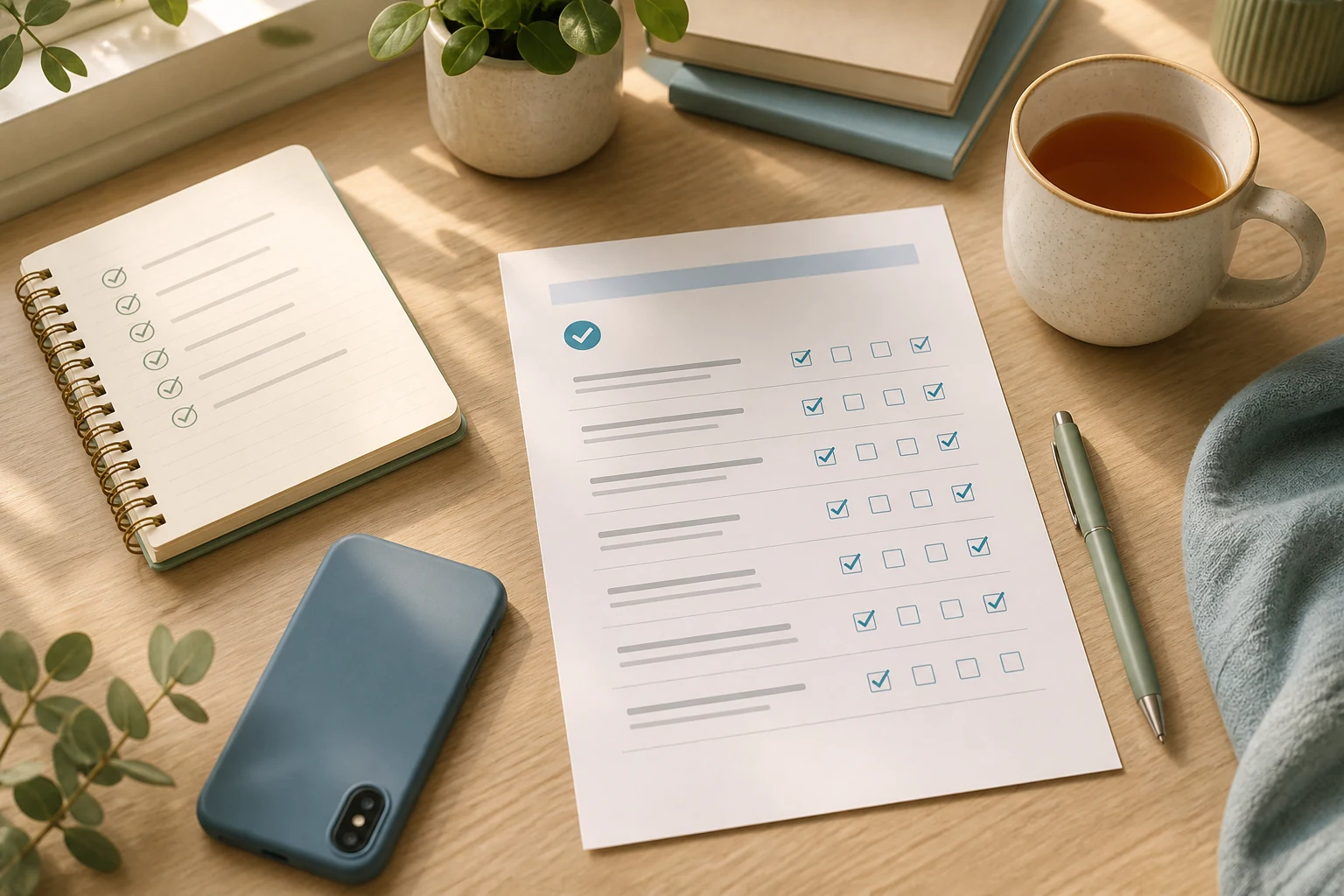
Most PHQ forms are short lists of symptom questions with multiple-choice frequency answers. The PHQ-9 asks about nine depression-related symptom areas over the past two weeks. Each answer has a score, and the total is used to describe a symptom range.
Does a high PHQ-2 score mean I have depression?
A high PHQ-2 score means follow-up may be useful. It does not settle the question by itself. Because the PHQ-2 has only two items, a professional may use the PHQ-9, another validated tool, and a fuller conversation to understand what is happening.
What is the 9 item Patient Health Questionnaire?
The 9 item Patient Health Questionnaire is the PHQ-9. It is a depression screening questionnaire with nine scored items, each based on how often a symptom has bothered you during the past two weeks. The total score ranges from 0 to 27.
What is the Patient Health Questionnaire for adolescents?
For adolescents, PHQ-style screening asks about mood and related symptoms in an age-aware context. Teen results should be interpreted with support from a qualified professional, and often with appropriate involvement from a parent, guardian, school counselor, or pediatric clinician.
What is a depression score test?
A depression score test is a structured screening tool that turns symptom answers into a numerical score. The score can help describe severity, track change, or guide a conversation. It should not be treated as a complete explanation of someone's mental health on its own.